







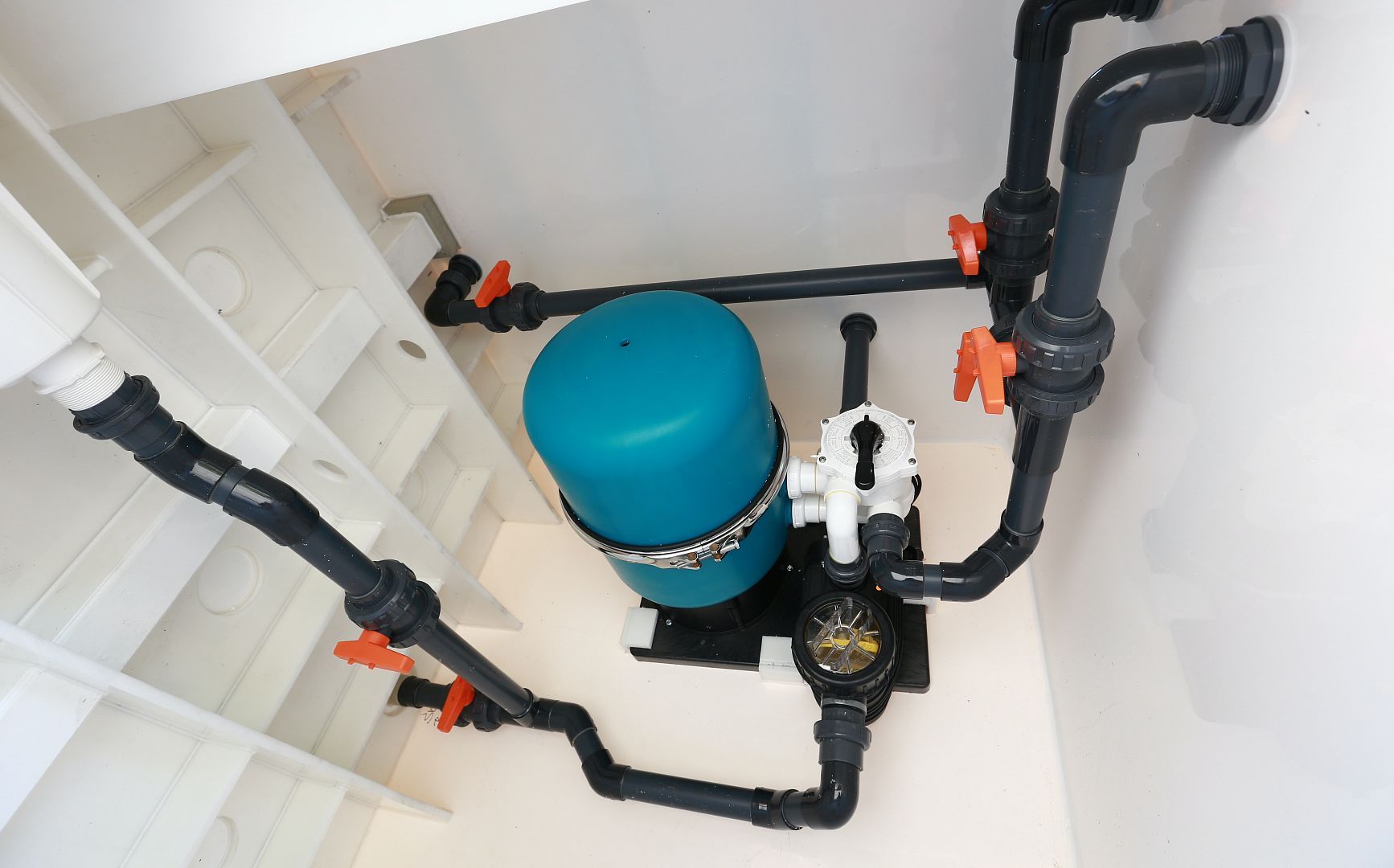
Sand filter for the pool: water cleaning without chemicals
Crystal clear pool water cannot be achieved without high-quality water filtration. That is why we have prepared an overview article for you about sand filtration, which is an essential part of every pool. You will learn what sand filtration is for, the principle on which it works, what the multi-layer filling of sand filters consists of, how to choose and connect a filter, as well as how to clean a pool sand filter and avoid sand filtration repairs. For DIY enthusiasts, we also have a brief guide on how to build a sand filter.
What is Sand Filtration?
Neither pools with chlorine-free water treatment nor pools with chlorine disinfection can function without sand filtration. Pool disinfection handles microbes and bacteria, but it won't get rid of grass, leaves, soil particles, pebbles, pollen, or dust. For that, you need sand filtration. Furthermore, sand filters minimize the occurrence of green or milky water cloudiness.
So, what exactly is it? It is a vessel filled with layers of fine sand that trap the aforementioned impurities. In some types of filtration, sand is replaced by filter glass or AFM activated filter media. However, we have found the standard sand filter with a pump to be the most effective.
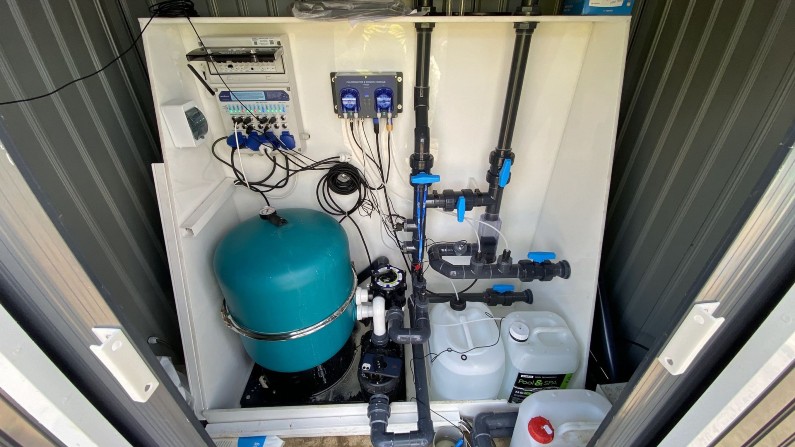
A pool sand filter ensures effective water cleaning by trapping impurities in fine filter sand.
Sand Filter Operating Principle
Sand filtration works on the same principle as water being purified in streams. In nature, just like in a pool, silica sand plays a vital role. Pool water is fed into the filter vessel containing sand, passing through the individual layers. Impurities remain in the sand, and only clean water passes through. Filter vessels should contain multiple sand grain sizes in the 0.6–1.2 mm fraction, which allows the filter to clean the water more effectively. This pool technology also includes valves that control the water flow and manage the cleaning cycle.
Sand Filters for Small Pools, Public Pools, and Hot Tubs
Sand filtration is suitable for both above-ground and in-ground pools. You can use it for any pool size and shape, including residential plastic garden pools and commercial pools for public swimming facilities. We are happy to provide home sand filtration systems, sand filtration solutions for up to 50 people, as well as filtration for hot tubs. In our product range, you will also find wellness pools, air blowers, and other pool accessories to create a wellness corner in a standard plastic pool.
How to Choose Sand Filtration
The performance (flow rate) plays the main role in selecting sand filtration. The system should be able to filter the entire pool volume twice a day. It should therefore be in operation for at least 8 hours a day to complete this task.
The performance of a pool sand filter with a pump is calculated using a simple formula: divide the pool volume by 4 to get the minimum cubic performance required for the pump. However, always choose a pool pump that is slightly more powerful than your calculation suggests. When choosing, also keep in mind that filtration performance decreases proportionally to the distance from the pool. Therefore, place the filtration in a pool house or a technology pit located near the pool.
Advantages and Disadvantages of Sand Technology for Pools
- Cleans water without chemicals
- Reduces the consumption of other pool chemicals
- Maintains pH levels
- Removes mechanical impurities
- Backwashed using only water without chemicals
- Minimal maintenance requirements
- Can be combined with other accessories
As mentioned, while sand filtration cleans the water, it cannot disinfect it or destroy bacteria and microbes. For that, you need to choose a method of pool disinfection. Our comparison of chlorine and chlorine-free water disinfection can help you choose the right pool technology and water disinfection method.
Location of Pool Filtration
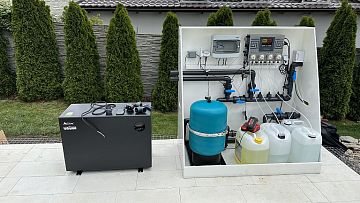
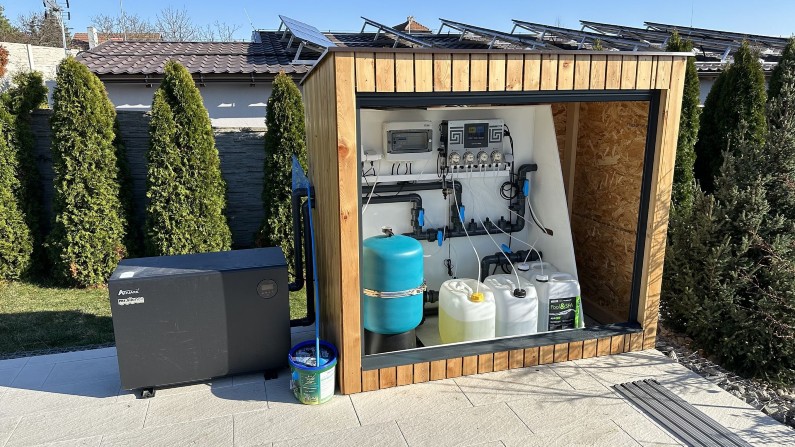
Place the filter, along with other pool technology, in a pit, a pool house, or another suitable space where the filter and pump will be protected from rain and dust. The space must also be well-ventilated. The floor of the room should be concrete or at least have a sand base. When choosing a location, think about your comfort and safety so that you can move around the space comfortably even after the installation of the technologies.
The distance from the pool is also important. The filtration should be placed at a distance according to the IP protection rating of the specific model. A distance of 2–3 m is most commonly recommended. Greater lengths lead to a reduction in pressure and suction pump performance. Placing it closer poses a risk to electrical components. However, the distance is always individual and depends on the specific model. A general rule is that the sand filtration pump should be located below the pool water level.
Connecting Sand Filtration
Connecting the filtration varies slightly depending on whether you have a skimmer pool or an overflow pool. One thing is certain: always install the pump before the filtration.
Connecting Sand Filtration to a Skimmer Pool
Before connecting the filter to skimmer pools, you need to ensure you have these components:
- Transition valve
- Reducers
- Several sections of hose
- Hose clamps
Before you start connecting the filter, close all openings to the pool and connect the skimmer. Attach a hose to the skimmer so it can draw water from the surface, and connect the other end to the filtration. A second hose will run from the filter to the upper outlet valve for clean water. If your filter is above the water level, install a fixed valve between the skimmer and the filter. When ordering, ask for a sand filter including a valve.
Installing Filtration for an Overflow Pool
The installation of a sand filter for overflow pools is very similar to the installation for a skimmer pool. The difference is that in overflow pools, water enters the cleaning process via the overflow edge, from where it is directed to the sand filter. The rest of the installation is the same.
Starting Up the Sand Pool Filtration
Finally, connect the filter to a pool control panel or intelligent control system, which allows you to operate the filtration. After connecting the sand filter, let water into the vessel and fill the pre-filter with water. The filtration must never run without water. Once filled, simply turn the filtration on. Then check the tightness of all hose connections and seal them if necessary.
Maintenance and Service of Pool Sand Filtration
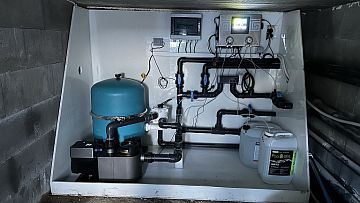
After a certain period of operation, sand filtration will naturally become clogged with impurities, making regular sand filter maintenance necessary. However, the sand does not need to be changed every time; cleaning the filter is sufficient. Once every 14 days, backwash the filter for at least 3 minutes. How to do it? Direct the water into the filter from the opposite direction to its normal flow. This will agitate the sand and release the impurities, which are then washed away into the drain.
After 3 to 5 years, however, the sand becomes so clogged that it needs to be replaced. After this time, the sand grains are too worn down and could damage the pump. You can buy new sand in 25 or 50 kg packs. Before using new sand, backwash it again.
Winterizing and De-winterizing Sand Filtration
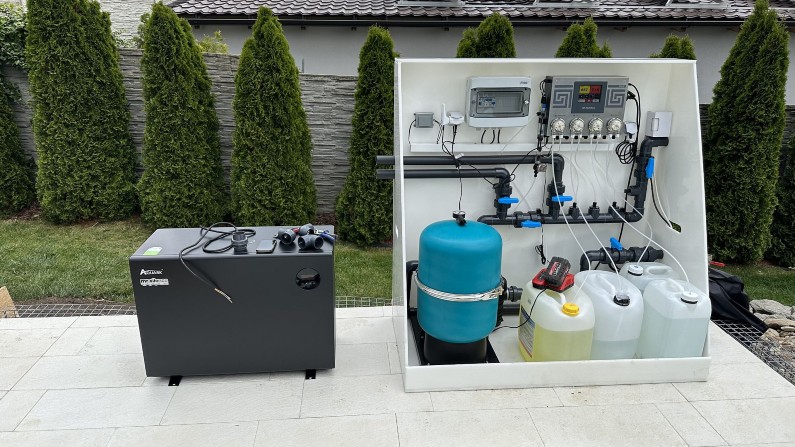
Before the cold weather arrives, you should winterize your pool filtration. Start by draining and disconnecting the filtration from the circuit. The filter vessel should have a screw designed specifically for draining water. Do the same for the pump, which we also recommend disconnecting and storing for the winter along with the valve.
Sand Filtration Faults
The most common sand filtration issues include:
- Sand entering the pool
- Air in the filtration system
- Filter clogging and increased pressure on the gauge
- Insufficient elimination of green water
This also includes pump-related problems, such as noise, weak performance, or the circuit breaker tripping when the pump is turned on.
Pool Filtration Service
If you don't feel confident cleaning the filter yourself or if you've discovered problems, contact us. In addition to selling plastic pools including accessories, we also offer pool technology service. Repairing or renovating pool filtration, servicing the pool, pool lights, or heat pumps is no problem for us. Just contact us.
Building Sand Technology for Pools
You can find many guides and tips online on how to build a sand filter or how to make a sand filter out of crates, for example. We have compiled a simple guide for you on how to build a sand filter. To build home-made sand filtration, you will need:
- Plastic container
- Inlet pipe
- Silica sand
- Inlet device
- Outlet pipe
- Cordless drill
- Two-component glue
- Plug suitable for sealing the pipe
- Pump
- Plastic bottle and a stocking
At the bottom of the plastic container (a bucket with a lid), place a drainage chamber with a drainage pipe. Cut holes in the pipe and pull a stocking over it. This will keep the sand in the filter while only clean water returns to the pool. This is where the purified water will flow. Create a hole in the side of the bucket or the lid for the dirty water pipe. Then fill the container with sand, but not quite to the top. Finally, close the bucket tightly and seal all pipes. We also recommend using a PET bottle and a stocking to create a so-called pre-filter, or additional filter for coarse impurities for the sand filtration system.
Chlorine-free Water Treatment and Other Accessories for a Clean Pool
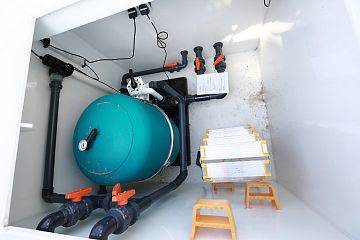
To achieve perfectly clean water, you will also need a method of pool water disinfection. If you experience rashes or chlorine allergies after swimming in chlorinated water, you can also choose alternative chlorine-free water disinfection. We offer, for example, UV lamp or ozone disinfection. You can read more about the issue of water disinfection in our article on methods of pool water treatment and cleaning.
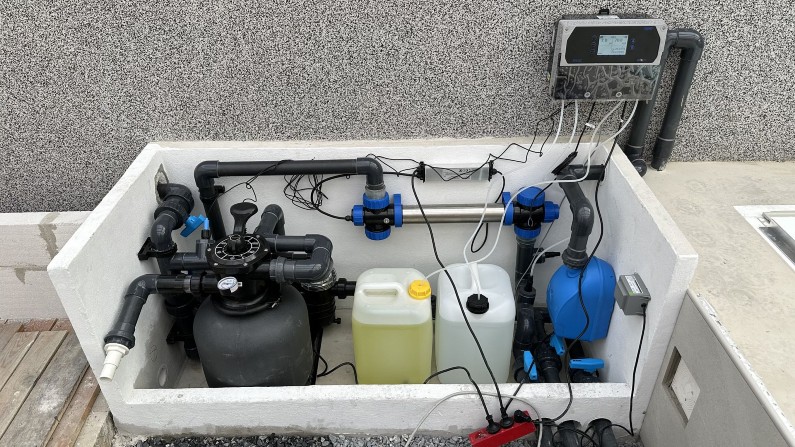
Chlorine-free disinfection keeps pool water clean and gentle on the skin and the environment.
Enclosures and Other Accessories for Maintaining a Clean Pool
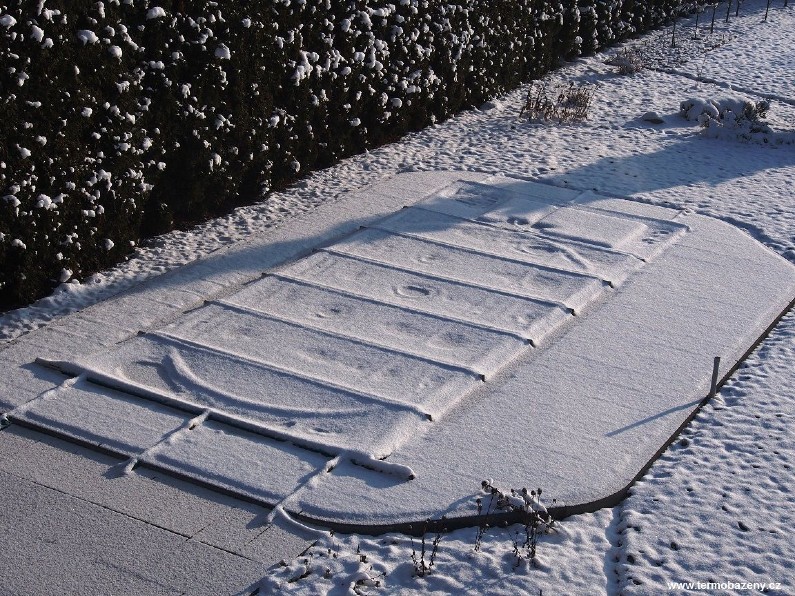
To prevent coarse impurities from entering and accumulating, you should enclose or cover your pool. You can choose from various forms of pool enclosures or pool covers, ranging from winter covers and solar covers to safety covers. Furthermore, less heat escapes from an enclosed pool, allowing you to extend the swimming season even without water heating technology. Discover other advantages of pool enclosures in our enclosure guide.
A pool vacuum cleaner will also help in the fight against impurities. You can choose from our automatic pool vacuum cleaners or manual pool vacuum cleaners.
Sand Filtration, Pool Technologies, and Custom Plastic Pools from Morava Ekol
With over 30 years of experience, we have become true experts in the field of plastic pools, including pool technologies and pool accessories. We can easily manufacture a custom pool for our customers or provide a pool including a skimmer, sand filtration, and steps according to your wishes. Originally, we started with manufacturing wastewater treatment plants; today, we can also handle plastic tanks, pits, and sumps, oil and petroleum substance separators, or almost any atypical plastic production.
Explore our blog, where we advise you on choosing an indoor pool or a garden pool and pool shapes including steps, compare skimmer vs. overflow pools, or intelligent control and pool control panels. We are happy to advise you personally on specific questions. Contact us.
Latest articles from the blog
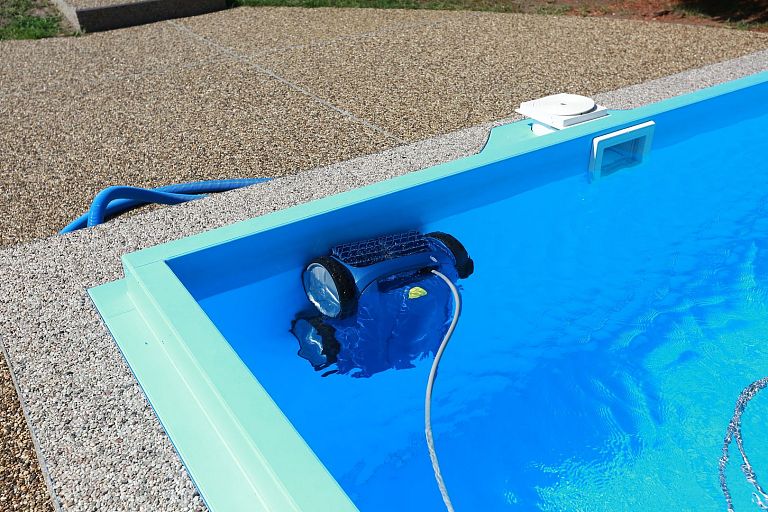

Automatic pool cleaner vs. Manual pool vacuum
Which pool floor and wall cleaner should you choose? Manual or automatic? We will advise you on which one to pick for a skimmer…
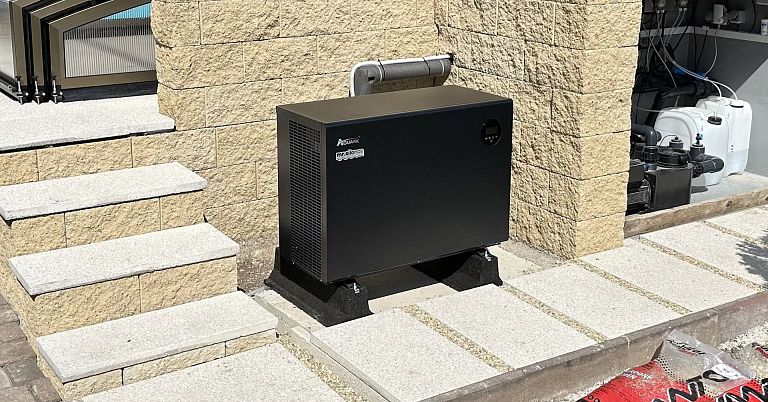
Pool water heating - which heating method is right for your pool
Do you want to extend your pool season or relax in the warm water? The water heater makes it easy to do so. Find out what water…